There's a moment, somewhere between your third downward dog and the instructor's gentle reminder to "breathe into your hips," when you start to wonder if yoga is actually doing anything. No sweat. No burning quads. No satisfying sense of destruction that most of us have been trained to associate with a "real" workout.
And then you stand up the next morning and your hamstrings remind you — loudly — that something happened.
That's the quiet genius of yoga. And its close cousin Pilates has a similar trick: the exercises look deceptively manageable right up until your core is shaking and you're quietly reassessing every life decision.
Together, yoga and Pilates represent a different philosophy of fitness — one that's less about punishing the body and more about educating it. And in an era of burnout, chronic injury, and general physical disconnection, that philosophy is having a serious moment.
A Tale of Two Practices
Yoga is ancient. Pilates is modern. That single fact tells you a lot about how each one thinks about the body.
Yoga traces its roots back over 5,000 years to the Indus-Sarasvati civilization in northern India. What most Westerners practice today — the flowing sequences, the held poses, the emphasis on breath — is primarily asana, just one of yoga's eight classical limbs. The physical practice was always meant to prepare the body for meditation, not the other way around. The flexibility, the strength, the stillness: they were byproducts of a larger spiritual project.
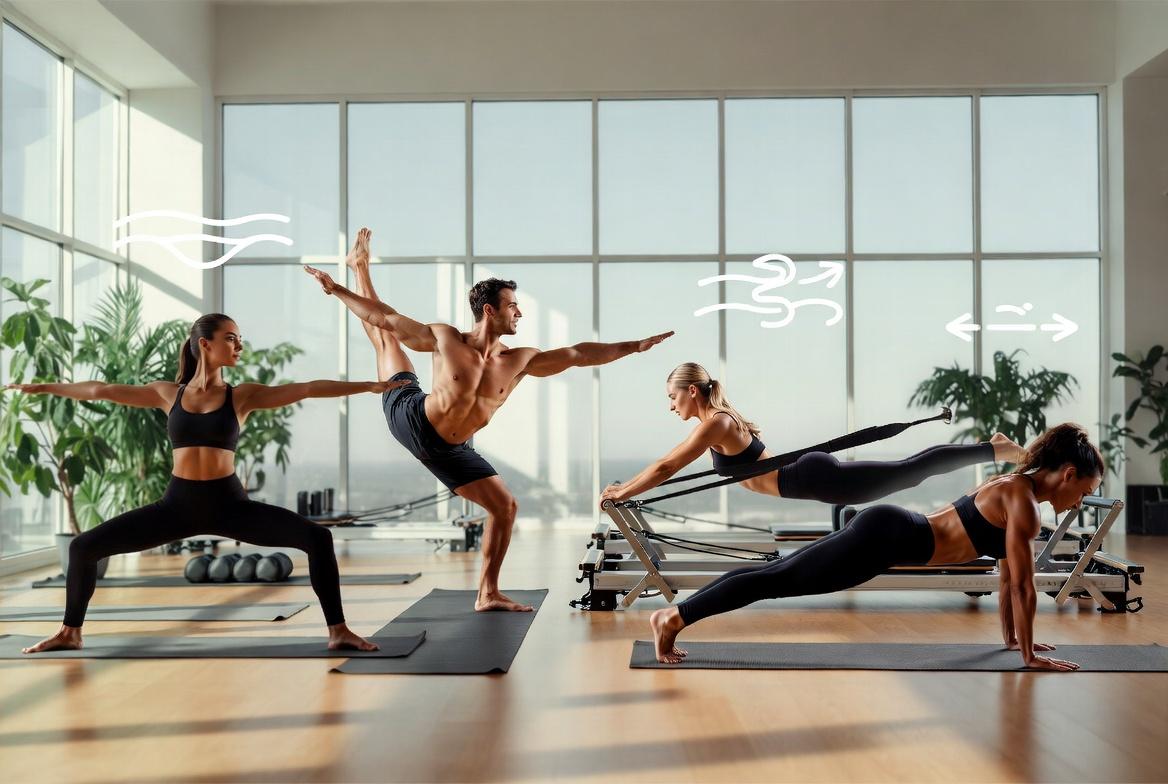
Joseph Pilates was a German-born fitness innovator who developed his method in the early 20th century, initially to rehabilitate injured World War I internees and later to condition dancers, especially at the New York City Ballet. He called his system "Contrology" — the art of controlling the body through focused movement. Where yoga emerged from philosophy, Pilates emerged from anatomy. Its language is clinical: neutral spine, transverse abdominis, scapular retraction. Its equipment — the Reformer, the Cadillac, the Wunda Chair — looks, slightly unsettlingly, like something designed by a very principled engineer.
Both practices have since evolved far beyond their origins. Yoga has fragmented into dozens of styles, from the fiery intensity of Bikram to the near-stillness of Yin. Pilates has developed its own spectrum, from gentle mat work to high-intensity reformer circuits that rival strength training. The two have even begun to blur together — "Yogalates" is a real genre, and some studios offer hybrid classes that are essentially both practices stitched into a single hour.
But their core philosophies remain distinct, and understanding that distinction is the key to knowing which one — or which combination — actually serves your body.
What Yoga Actually Does to Your Body
Strip away the Sanskrit, the incense, and the Instagram aesthetics, and yoga is a sophisticated physical training system built around three fundamental demands: flexibility, balance, and integrated strength.
Flexibility gets most of the attention, and for good reason. Regular yoga practice genuinely lengthens muscles and increases joint range of motion, particularly through static and dynamic stretching of the hips, hamstrings, spine, and shoulders. For most adults who spend eight or more hours a day sitting, these are precisely the areas that tighten into dysfunction. The hip flexors shorten. The thoracic spine rounds. The shoulders creep forward. Yoga systematically addresses all of it.
But strength is where yoga surprises people. Holding a warrior pose for sixty seconds is an isometric exercise. Transitioning through a sun salutation is a bodyweight circuit. Arm balances like crow or side plank require genuine upper body and core strength. The difference from conventional strength training is that yoga builds strength through full ranges of motion — you're strengthening the muscle at the same time as you're lengthening it, which creates a different, often more functional kind of strength than isolated gym exercises.
Balance training is the underrated component. Every single-leg pose — tree, warrior III, half moon — trains proprioception, the body's ability to sense its own position in space. This is not just useful for balance itself; proprioception is foundational to injury prevention, athletic performance, and the kind of coordination that makes all physical movement feel easier and more natural.
Then there's the nervous system. Yoga's emphasis on breath, specifically the long, controlled exhales of pranayama practice, activates the parasympathetic nervous system — the "rest and digest" counterpart to the adrenaline-driven "fight or flight" response. This has measurable effects on cortisol levels, heart rate variability, blood pressure, and sleep quality. For people whose daily lives involve chronic stress, this regulation is arguably the most significant physical benefit yoga offers. It's not relaxation theater. It's genuine physiological recalibration.
What Pilates Actually Does to Your Body
Pilates starts from a different premise. Where yoga asks the whole body to move, Pilates first asks the body to be still in the right way — specifically, to stabilize the spine and pelvis — and then to move from that stable foundation.
The concept of the "powerhouse" — Pilates' term for the deep core muscles including the transverse abdominis, multifidus, pelvic floor, and diaphragm — is central to everything. Before your limbs do anything interesting, your powerhouse needs to be engaged. This isn't the superficial core engagement of crunches; it's the deep, 360-degree stabilization that your body should be doing automatically but has often forgotten how to do because of sedentary habits, poor posture, or old injuries.
This is why Pilates is consistently recommended for back pain. The lumbar spine is only as stable as the muscles that surround it. When those deep stabilizers are weak or incoordinated, the spine takes forces it wasn't designed to bear, and discs, facets, and ligaments eventually protest. Pilates re-educates those muscles with extraordinary precision, often resolving chronic back pain that has persisted through years of other treatments.
Beyond the back, Pilates excels at postural correction. The method's attention to spinal alignment, shoulder positioning, and hip symmetry essentially teaches the body better movement habits — ones that carry over into daily life and other activities. Runners with hip imbalances, cyclists with rounded shoulders, office workers with compressed lumbar curves: Pilates addresses all of these patterns at their source.
The Reformer, Pilates' signature piece of equipment, adds a dimension that mat work alone can't replicate. Its spring-loaded resistance system creates a unique training stimulus — the springs both assist and resist movement depending on the exercise, allowing the same movement to be either rehabilitative or intensely challenging. On a Reformer, exercises that look simple become genuinely hard, and the controlled resistance forces proper muscle recruitment in ways that bodyweight alone doesn't always achieve.
Advanced Pilates is also a serious strength and power modality. Jump board work on the Reformer is plyometric. Footwork exercises challenge the entire posterior chain. The advanced mat repertoire — jackknife, control balance, boomerang — demands flexibility, strength, and coordination simultaneously. At this level, the idea that Pilates is just for gentle rehabilitation becomes obviously absurd.
The Numbers Behind the Practice
Research has been catching up with what practitioners have known for decades.
A 2015 study published in the Journal of Physical Therapy Science found that 12 weeks of yoga practice significantly improved flexibility, balance, and upper body strength in sedentary adults. A 2021 meta-analysis in the British Journal of Sports Medicine confirmed yoga's effectiveness for reducing chronic lower back pain — comparable to other exercise interventions and better than no treatment.
For Pilates, a 2011 review in the Journal of Orthopaedic & Sports Physical Therapy found strong evidence for its effectiveness in reducing chronic non-specific low back pain. Multiple studies have shown improvements in core endurance, postural alignment, and dynamic balance following structured Pilates programs. For older adults specifically, Pilates has been shown to improve bone density, fall prevention, and functional movement capacity.
Neither practice has the cardiovascular training effect of running or cycling at steady state. That's an honest limitation. But yoga classes with minimal rest between sequences — vinyasa, ashtanga, hot yoga — can elevate heart rate into aerobic training zones. And in terms of metabolic health, resistance exercise like mat Pilates and reformer work improves insulin sensitivity and metabolic rate in ways that pure cardio doesn't.
The point isn't to crown one practice as superior. It's to understand what each one delivers so you can use it strategically.
Head-to-Head — Yoga vs. Pilates
Here's an honest, direct comparison across the dimensions that matter most for fitness:
| Category | Yoga | Pilates |
|---|---|---|
| Core Strength | Moderate — engaged in most poses but not the primary focus | Excellent — deep core stabilization is the foundation of every exercise |
| Flexibility | Excellent — systematic work on all major muscle groups | Moderate — flexibility is improved but not the primary emphasis |
| Back Pain Relief | Good — spinal mobility and stress reduction both help | Excellent — deep stabilizer retraining directly addresses most back pain causes |
| Cardiovascular Benefit | Low to moderate (style-dependent) | Low to moderate (intensity-dependent) |
| Strength Building | Moderate — bodyweight strength, particularly upper body and legs | Good to excellent — especially with reformer work; better load progression |
| Balance & Coordination | Excellent — proprioception training built into practice | Good — especially in standing and dynamic exercises |
| Stress Reduction | Excellent — breath-focused, parasympathetic activation | Good — mindful movement helps, but less emphasis on breath regulation |
| Injury Rehabilitation | Good — gentle styles are very rehabilitation-friendly | Excellent — originated as rehabilitation method; high clinical evidence |
| Equipment Required | Minimal (mat, optional blocks and straps) | Mat work needs no equipment; full Reformer work requires studio access |
| Learning Curve | Moderate — basic poses accessible, advanced poses take years | Moderate — principles take time to internalize; Reformer adds complexity |
| Postural Correction | Good — awareness-focused | Excellent — biomechanically precise approach to alignment |
| Athletic Performance | Good — mobility and balance improve most sports | Excellent — used by professional athletes for performance and injury prevention |
| Accessibility for Beginners | High — beginner classes widely available, many free online | Moderate — mat work accessible; Reformer requires studio instruction |
| Cost | Low to moderate (class fees or free online) | Moderate to high (Reformer classes more expensive than mat) |
| Mind-Body Connection | Deep — philosophical framework for attention and presence | Strong — precision of movement demands focus |
| Community/Culture | Extensive — global community, varied sub-cultures | Smaller but growing, especially among fitness professionals |
The Case for Doing Both
The question isn't really "yoga or Pilates?" for most people. It's "how do I structure a practice that makes my body work better?"
And for that question, the two practices are genuinely complementary. Yoga builds the flexibility that allows Pilates exercises to be executed with full range of motion. Pilates builds the core stability that makes yoga balancing poses and arm balances more accessible. Yoga trains the nervous system to down-regulate; Pilates trains the neuromuscular system to recruit more precisely. The breath awareness from yoga carries over into Pilates; the postural consciousness from Pilates carries over into yoga.
Many strength athletes and runners use yoga primarily as a recovery and mobility tool — three to four sessions a week of yoga alongside their primary training, specifically targeting areas of tightness and restriction. Many others use Pilates as their primary strength work, combining it with walking or cycling for cardiovascular training. Both approaches work. The main failure mode isn't choosing the wrong practice; it's not committing to consistency with either one.
Choosing Your Style
Both practices offer enough variation that "yoga" and "Pilates" are almost umbrella terms.
Within yoga, the major styles and their fitness implications break down roughly as follows. Hatha yoga — the generic term for physical yoga practice — tends to be slower-paced and pose-focused, making it excellent for beginners and recovery. Vinyasa and flow yoga link breath to movement in continuous sequences, offering a more cardiovascular challenge. Ashtanga is a set sequence of poses practiced in a specific order, progressively intense and demanding. Yin yoga involves long, passive holds (three to five minutes per pose) targeting connective tissue and joint mobility. Restorative yoga uses props to support the body in complete relaxation — legitimate stress-reduction and recovery work. Hot yoga (Bikram or otherwise) adds heat to the equation, increasing flexibility and cardiovascular load while raising valid concerns about dehydration for some practitioners.
Within Pilates, mat-based work is the most accessible entry point — the original exercises Joseph Pilates designed, performed on the floor with bodyweight. This is what most free online Pilates content involves. Studio Pilates on the Reformer or other apparatus offers greater variety, resistance progression, and precision, and is particularly valuable for rehabilitation or serious athletic conditioning. Contemporary Pilates has evolved to incorporate more modern exercise science and biomechanical research; classical Pilates maintains fidelity to Joseph Pilates' original system. Both are effective; classical tends to be more intense and technically demanding.
The Elephant in the Room — Is This Enough?
Let's be direct about something the wellness industry often isn't: yoga and Pilates alone, for most people, will not produce significant cardiovascular fitness, substantial muscle hypertrophy, or the kind of bone density benefits that come from high-impact or heavy-load training. If those are your goals — and they're worth having — you need to pair these practices with cardiovascular exercise and, ideally, some form of resistance training.
What yoga and Pilates will do is make everything else work better. Better movement quality means better form in the gym, less injury risk, and more efficient recovery. Better flexibility means less pain and restriction in daily life. Better core stability means safer movement under load. Better stress regulation means better sleep, better hormonal balance, and better recovery from hard training.
The athletes who have made yoga and Pilates serious parts of their training — LeBron James, Cristiano Ronaldo, Andy Murray, Serena Williams — don't do them instead of their primary conditioning. They do them because they extend careers, prevent injuries, and optimize recovery in ways nothing else quite replicates.
Getting Started Without Getting Overwhelmed
The single biggest mistake people make with both practices is expecting too much too soon and quitting when they feel uncoordinated, inflexible, or confused by the terminology.
Every expert in a yoga class was once someone who fell out of tree pose repeatedly. Every Pilates regular was once someone who couldn't feel their transverse abdominis no matter how many times the instructor said "draw your navel to your spine."
Start with committed, consistent beginner-level work. Eight to twelve weeks of two to three sessions per week at a beginner level will give you enough foundation to progress, feel genuine results, and understand which practice (or which style within each practice) actually resonates with how your body learns and what your body needs.
For yoga, in-person beginner classes remain the best starting point because an instructor can offer hands-on adjustments and spot form issues that video can't address. Online platforms like Yoga With Adriene, Glo, and Down Dog offer high-quality beginner content if studio access is limited.
For Pilates, a few one-on-one or small-group sessions before jumping into a full studio class is genuinely worthwhile — the principles of core engagement are subtle enough that having them taught individually before you're in a large group setting saves a lot of confused non-progression. Many studios offer introductory packages precisely for this reason.
The Bigger Picture
The fitness industry has spent decades selling intensity. The implicit message — sweat more, push harder, destroy and rebuild — is deeply embedded in how most people think about what it means to exercise properly.
Yoga and Pilates operate from a different premise. Not softer, exactly. Anyone who has held a full wheel pose or completed a Pilates hundred at full intensity knows these practices can be demanding to the point of humility. But the goal is different. The goal is not destruction but education — teaching the body better movement patterns, greater awareness, more intelligent use of strength and stability.
The body you build through yoga and Pilates is not a body optimized for looking powerful. It's a body optimized for being powerful — mobile, stable, resilient, coordinated, and capable of decades of function rather than years of performance followed by breakdown.
That's a trade worth making. And the fact that it also reduces stress, improves sleep, builds genuine community, and requires nothing more than a mat and some floor space makes it one of the most practical investments in health that exists.
The two practices, old and new, ancient and clinical, spiritual and anatomical, have arrived at the same place from opposite directions: the body knows how to move well. Sometimes it just needs to be reminded.
Ready to begin? The mat is the easy part. Showing up is the practice.