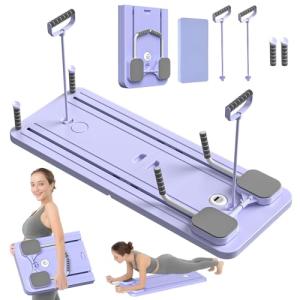
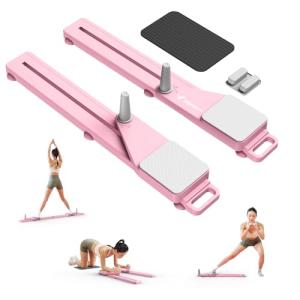
A Little History
Joseph Pilates didn't just invent a series of floor exercises — he built an entire system of apparatus to go along with them. He developed his method in the early 20th century, initially working with hospital patients and later with dancers and athletes. His insight was that most people struggle to perform mat exercises well because they've lost the body awareness and connection needed to do them correctly. The machines he created were designed to give people that connection back — to teach the body how to move, not just force it to go through the motions.
That original philosophy still holds true today. Every Pilates machine you'll encounter is built around the same idea: use springs, pulleys, and body weight to guide movement, provide feedback, and build strength from the inside out.
The Pilates Reformer: The Machine Everyone Talks About
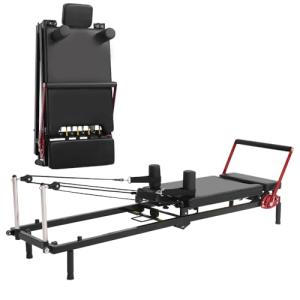
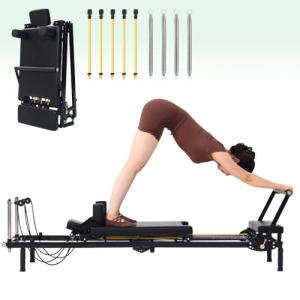
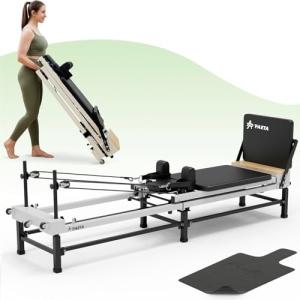
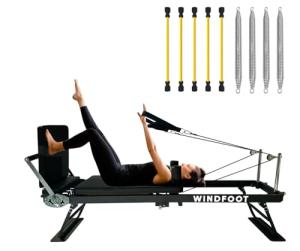
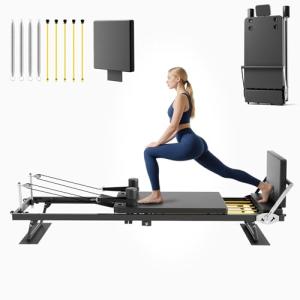
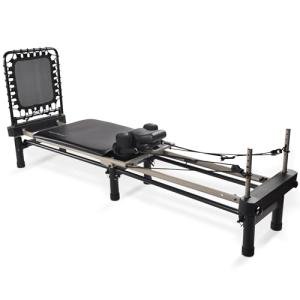
The Reformer is the star of the Pilates equipment world, and for good reason. It's a long, bed-like frame with a sliding carriage in the middle, adjustable spring resistance, a footbar at one end, and straps for your hands or feet. You can lie down, sit up, kneel, stand, or balance on it — often within the same workout session.
What makes the Reformer so popular is its adaptability. Spring tension is adjustable, so a complete beginner can use it with lighter resistance while an advanced practitioner can crank it up and challenge their entire body. The sliding carriage creates a kind of moving platform that forces your stabilizer muscles to engage constantly, even when you think you're just doing a simple leg press.
A full Reformer session typically covers the core, legs, glutes, back, arms, and shoulders — all in one go. But it's not just about strength. The Reformer is equally good for lengthening muscles, improving posture, and building the kind of deep body awareness that carries over into everyday movement. Athletes use it for injury prevention and cross-training. Physiotherapists recommend it for rehabilitation. Dancers have been training on it for decades.
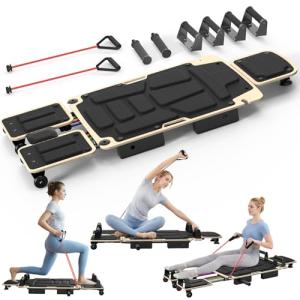
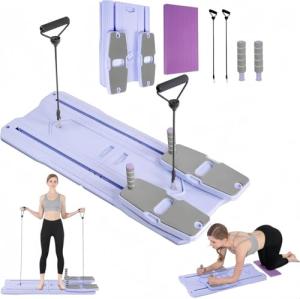
For home use, folding and tower-integrated Reformer models have made it increasingly practical to bring studio-quality training into a spare room or garage. If you're new to Pilates equipment and aren't sure where to start, the Reformer is almost always the right first step.
The Cadillac (Trapeze Table): The Machine That Does It All
The Cadillac — also called the Trapeze Table — looks a bit like a hospital bed crossed with a four-poster frame. A wide, padded mat sits at its base, and above it rises a metal structure fitted with horizontal and vertical bars, adjustable springs, straps, loops, a push-through bar, and a roll-down bar. Some versions even feature trapeze-like hanging loops that let you suspend parts of your body mid-air.
It's the most versatile piece of Pilates equipment in existence. On the Cadillac, you can work in almost every position imaginable — lying flat, sitting upright, kneeling, hanging, or suspended partially off the side. This range of motion and positioning makes it uniquely valuable for two quite different groups: people doing advanced Pilates who want maximum variety, and people in rehabilitation who need gentle, supported movement.
The Cadillac excels at spinal work. Exercises on this machine decompress the spine, encourage healthy articulation through each vertebra, and open up the shoulder girdle in ways that other apparatus simply can't replicate. If you struggle with tight hips, a stiff thoracic spine, or chronic postural issues from desk work, spending time on the Cadillac will feel like a revelation.
Its size — it typically requires around eight feet by two feet of floor space, plus clearance all around — makes it more of a studio fixture than a home purchase, though combined Cadillac-Reformer units have become popular for home gyms with adequate space.
The Wunda Chair: Small Box, Serious Challenge
Don't let the compact size fool you. The Wunda Chair is a deceptively challenging piece of equipment. It looks like a small padded stool with a spring-loaded pedal (or two pedals) built into one side. You press the pedal down against spring resistance, and that's where things get interesting.
Because the surface area is so much smaller than a Reformer or Cadillac, your body has to work significantly harder to maintain balance and control. Your core fires constantly. Small imbalances between your left and right sides become immediately obvious. Exercises that feel manageable on the Reformer can suddenly demand twice the focus and concentration on the Chair.
The Wunda Chair targets the lower body and deep core with particular intensity. Standing exercises challenge your legs, glutes, and stabilizing muscles in a functional, weight-bearing way that's difficult to replicate on any other machine. Seated and kneeling exercises hammer the core from multiple angles. The range of movements possible — including lunges, pikes, side-lying leg work, and upper body exercises using the handles — is broader than the Chair's modest footprint suggests.
It's also one of the most practical options for home studios and smaller spaces. Its compact dimensions mean it can fit into corners or rooms where a Reformer wouldn't stand a chance. Many serious Pilates practitioners who've outgrown mat work add a Chair to their home setup before committing to the larger machines.
The Ladder Barrel: Built for Spine and Stretch
The Ladder Barrel consists of a curved, barrel-shaped padded surface attached to a base with rungs — like a small ladder — at one end. It's a simpler machine in terms of mechanical parts, but its uses for spinal health and flexibility are significant.
Draping your spine over the barrel's curved surface provides a supported backbend that decompresses the vertebrae and opens the chest and hip flexors in a deeply satisfying way. Side-lying stretches on the barrel address the lateral line of the body — the obliques, the IT band, and the muscles along the sides of the torso — that often get neglected in standard exercise routines.
It's also used for advanced core exercises. The Teaser, one of Pilates' most iconic and demanding movements, can be practiced on the Ladder Barrel with the ladder rungs providing support or added challenge depending on your positioning. Spinal extension work on the barrel helps counteract the effects of hours spent hunched over desks and screens.
The Ladder Barrel is often seen as a complement to the Reformer rather than a standalone piece. Studios typically have a few positioned around the room for use during and between sessions. For home use, it's a worthwhile investment if spinal mobility and deep stretching are priorities.
The Arc Barrel: The Smaller, More Versatile Sibling
The Arc Barrel (sometimes called the Spine Corrector) is essentially a smaller, wedge-shaped version of the Ladder Barrel. It lacks the ladder component but retains the curved surface for spinal work, and its reduced size makes it far more practical for home use.
Despite being one of the most affordable and compact pieces of Pilates apparatus, the Arc Barrel offers a surprisingly wide range of exercises. It can be used under the lower back for supported abdominal work, placed under the hips for back extension exercises, used for side-lying oblique work, or sat upon for balance and coordination challenges. It travels well and takes up minimal floor space.
If you're building a home Pilates setup and looking for bang for your buck, the Arc Barrel often makes more sense than the full Ladder Barrel. It handles most of the same exercises in a smaller, more accessible package.
The Pilates Tower (Wall Unit): Studio Versatility Without the Full Reformer
The Pilates Tower, sometimes called a Wall Unit, is essentially a vertical tower of springs and bars mounted to a wall or attached to the end of a Reformer. It brings many of the spring-based exercises of the Cadillac into a much more compact footprint.
Tower units typically include a push-through bar, roll-down bar, arm and leg springs, and various attachment points. This setup makes it possible to perform hundreds of different exercises without owning a full Cadillac. Many home practitioners pair a Reformer with a Tower attachment to get close to the full studio experience in a single unit.
The Tower is particularly good for standing spring work, roll-down exercises that develop spinal flexibility and articulation, and shoulder and arm work using the various spring attachments. It bridges the gap between Reformer and Cadillac nicely.
Choosing the Right Pilates Machine
With so many options, it helps to think about this in simple terms.
If you're new to Pilates equipment and want something that covers your entire body with room to grow for years, the Reformer is your answer. It's the machine that most Pilates beginners start on, and most experienced practitioners never stop using.
If rehabilitation, spinal health, or gentle supported movement is your priority, the Cadillac is worth the investment. Its ability to work the body in suspended and supported positions makes it uniquely therapeutic, and it's widely used in physiotherapy settings for good reason.
If you're working with limited space but want real challenge and don't want to stick to mat work forever, the Wunda Chair punches well above its weight. It's small, it stores easily, and it will push you harder than you expect.
If flexibility, spinal mobility, and deep stretching are where you want to focus, a Ladder Barrel or Arc Barrel rounds out a home studio beautifully and provides something the other machines simply can't.
If you want the biggest possible range of exercises in the smallest possible footprint, a Reformer with Tower attachment covers an enormous amount of ground and is often the smartest investment for home gyms with limited square footage.
What to Look for When Buying
Regardless of which machine you choose, a few factors always matter. Build quality is non-negotiable — look for solid hardwood or aircraft-grade aluminum frames, high-quality spring mechanisms, and well-padded carriage surfaces. A machine that wobbles, squeaks, or feels flimsy isn't just annoying: it undermines your workout and creates safety concerns.
Adjustability matters too. Springs should be easy to add or remove, footbars should be adjustable across multiple positions, and shoulder blocks and headrests should accommodate different body sizes. A machine that only works for one type of body will become limiting quickly.
Think about your floor space before you buy anything. Measure carefully, accounting not just for the machine's footprint but for the space you need to move around it — extending your arms overhead, stepping on and off, and transitioning between exercises without bumping into walls.
Finally, consider whether you're buying for personal use or studio use. Home Pilates machines are built for lighter, less frequent use than commercial-grade studio equipment. If you're running classes or expect heavy daily use, invest in commercial-grade apparatus.
Pilates machines are genuinely unlike anything else in the fitness world. They reward patience, attention, and consistency in ways that treadmills and dumbbells rarely do. The spring resistance talks back to your body in real time, exposing weaknesses and rewarding genuine control. Once you've worked on quality Pilates apparatus, most other gym equipment starts to feel comparatively blunt.
Whether you're setting up a home studio, outfitting a commercial space, or simply trying to understand what you're looking at before your next class, the right machine is out there — and now you know exactly what to look for.