There's a certain kind of optimism that drives people to buy home gym equipment. You picture early morning workouts in your own space, no commute, no waiting for machines, no monthly membership draining your bank account. Then reality creeps in — the squat rack crowds the garage, the cable machine needs its own zip code, and the rowing attachment you swore you'd use is now a very expensive coat rack.
The fitness industry has been slowly solving this problem for years, and the latest entrant to get it genuinely right is the Fitvids Multifunctional Full Body Workout Weight Machine Station. It's a name that doesn't exactly roll off the tongue, but the machine itself makes a compelling argument that you don't need an equipment arsenal to train like a serious athlete.
Why the "All-in-One" Home Gym Category Finally Makes Sense
A decade ago, the phrase "all-in-one home gym" was almost a punchline. It usually meant a flimsy cable contraption that could simulate about three exercises badly. The pulleys squeaked, the weight increments were uselessly large, and the whole thing wobbled when you so much as looked at it with intent.
The category has matured considerably. Brands like Bowflex, Body-Solid, and Marcy showed that compact multi-station machines could be legitimate training tools. But they often came with commercial-grade price tags that put them out of reach for the average home gym builder. That's the gap that Fitvids has stepped into — offering a machine with premium structural specs at a price point that doesn't require financing a second mortgage.
Fitvids builds their home gym with industrial-grade 1.5-inch steel tubing and aircraft-grade cables tested to 1,000 lbs. Those aren't marketing buzzwords — they're the kind of specs that separate equipment built to last from equipment built to photograph well for an Amazon listing.
First Look: What You're Actually Getting
Let's be straightforward about the unboxing experience: the Fitvids home gym ships in up to five separate packages, so you'll want to make sure all boxes have arrived before you start assembly. It's a minor logistical consideration, but worth knowing upfront — don't start bolting things together at 9pm on a Tuesday if box three is still somewhere in a FedEx warehouse.
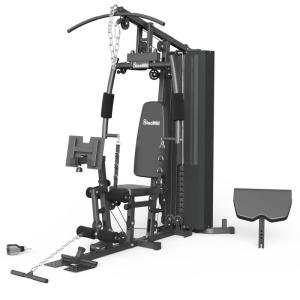
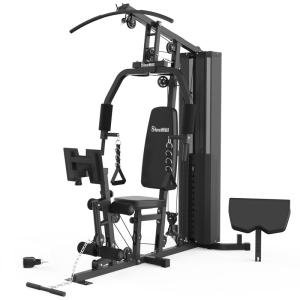
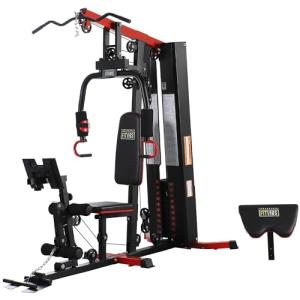
Once everything is laid out, the sheer scope of the machine becomes clear. Key parts include the long bar, push and clamp arm, 122.5 lb weight stack, leg exercise pedal, backrest cushion, kick bar, seat cushion, ankle strap, elbow cushion, and short bar.
The machine has a footprint of 42" x 68" x 78" — that's roughly the floor space of a large armchair. For a machine that replaces six or seven individual pieces of gym equipment, that's a genuinely impressive use of geometry.
The aesthetic is clean. The powder-coated finish looks great and resists scratches and sweat corrosion, which is essential for long-term durability. It's the kind of machine that won't make your home gym look like a salvage yard.
Build Quality: Steel Doesn't Lie
The fitness equipment market is littered with products that look robust in photos and feel like they're made of recycled soda cans in person. Fitvids is not that machine.
The Fitvids Home Gym System is made of high-quality steel, designed to support a maximum user weight of 400 pounds and a total weight capacity of 1,000 pounds. That's a serious structural rating — one that puts it on par with commercial-grade equipment used in professional training facilities.
The FitVids home gym is built with quality in mind, constructed from high-grade steel, supporting up to 400 pounds of user weight. For context, most budget cable machines cap out at 250 to 300 lbs user weight, which means they're not designed for heavier or more powerful athletes training at high intensity.
The cable system deserves particular attention. The full body workout machine is equipped with steel shaft pulleys and high-strength steel wire ropes to ensure quiet and safe operation. Quietness matters more than people realize — if you're training early in the morning or live in an apartment, a screeching pulley system turns every set into an apology to your neighbors.
The machine features high and low pulley systems with 15 pulleys for smooth, fluid motion and comprehensive muscle engagement. Fifteen pulleys is an unusually high count for a home machine, and it's what gives the cable movements their notably smooth feel — the resistance stays consistent throughout the range of motion rather than binding or jerking.
Exercise Versatility: The Real Selling Point
Here's where the Fitvids genuinely earns its price. The number of distinct movements you can perform on this one machine is what makes the "all-in-one" label actually accurate rather than aspirational.
From fitness exercise staples like lat pulldowns and butterfly chest to rowing machine simulations, one total gym conquers strength, cardio, and HIIT routines effortlessly, and is also friendly to beginners.
Let's break down the major movement categories:
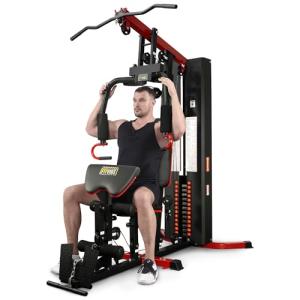
Upper Body Pulling: Lat pulldowns are the cornerstone of any cable machine, and the Fitvids handles these well via the high pulley. Wide-grip, close-grip, and reverse-grip variations are all accessible depending on which attachment you use. Seated cable rows hit the mid-back, rhomboids, and biceps, and the machine's seated rowing configuration gives you proper body positioning to load these muscles effectively.
Upper Body Pushing: The cable crossover and butterfly chest functions translate into pec fly movements that isolate the chest in a way that free weights struggle to replicate. The constant tension through the full range of motion is one of the genuine physiological advantages of cable training over dumbbells or a barbell.
Lower Body: Leg extensions target the quadriceps directly, while ankle strap-based movements through the low pulley allow for cable kickbacks, hip abductions, and glute work that you'd normally need a dedicated hip abductor machine to achieve.
Seated Rowing: The integrated rowing station is one of the more thoughtful inclusions. This multifunctional full-body workout weight machine station combines a weight stack, pulley system, and seated rowing into one compact unit designed for effective strength training at home.
Arm Isolation: Bicep curls via the low pulley and tricep pushdowns from the high pulley cover the standard arm isolation work. The preacher curl station is a particularly notable addition — it's a dedicated attachment that most cable machines at this price point simply don't include.
The 160 lb vinyl weight stack and 15-pulley setup provide consistent resistance and easy progression for all fitness levels.
The gym comes equipped with both a lat bar and a low row bar, both of which are detachable to allow for custom workout configurations. The foam handles add an extra layer of comfort and convenience, making even the most challenging exercises more manageable.
The detachable rod system deserves a specific callout. The rod is detachable and can be replaced with other training accessories, which means this machine has a future-proof quality to it — as you progress or your training interests evolve, you can expand the attachment library without buying a new machine.
The Weight Stack: How Much Is Enough?
Weight stack capacity is one of the most hotly debated specs among home gym buyers, and the answer is genuinely personal.
The strength training equipment has a 160-pound vinyl weight stack included. For cable-based exercises, this is more than sufficient for the vast majority of users. Here's why: because of the pulley ratio on most cable machines, the actual resistance felt at the handle is often different from the raw plate weight. Many exercises — chest flys, tricep pushdowns, cable curls — are rarely performed above 80 to 100 lbs even by experienced lifters.
Where the stack becomes a potential constraint is in movements like lat pulldowns for larger, more advanced athletes, or leg press variations where stronger individuals can handle higher loads. The weight stack may not be sufficient for very advanced lifters — that's a fair and honest observation. If you're a competitive powerlifter or someone who regularly lat pulls more than 150 lbs on a commercial cable machine, you may eventually feel the ceiling.
For everyone else — beginners, intermediate lifters, people focused on hypertrophy, athletes doing functional training, or anyone who wants a complete home gym that serves the whole family — the 160 lb stack is genuinely adequate and unlikely to be outgrown quickly.
The vinyl-coated weight plates are worth a mention too. Vinyl coating reduces the metallic clanging that makes weight stack machines noisy and unpleasant to use in a home environment. Each plate selector mechanism is straightforward — a standard pin selector that takes less than two seconds to adjust between sets.
Comfort and Ergonomics: Longer Sessions, Better Results
One area where budget home gym equipment consistently disappoints is padding. Thin, hard seat cushions and poorly positioned backrests turn what should be a productive training session into an exercise in endurance of a very different kind.
A soft seat cushion provides comfort for every movement. Fitvids uses foam padding that's dense enough to support your body under load without compressing into nothing after a few months of use. The backrest positioning allows for natural spinal alignment during pressing and rowing movements, which matters both for comfort and injury prevention.
The workout equipment includes sponge handle, calf blocks, and detachable ankle straps for injury-free training marathons. The ankle strap inclusion is notably practical — it's one of those accessories that inexplicably costs extra on many competing machines.
The sponge handles deserve specific mention. Handle comfort is one of the most underrated aspects of cable machine design. Hard or too-thin handles cause hand fatigue and affect grip during longer sets, which ultimately limits the quality of your training. The foam grip on Fitvids handles allows you to maintain a secure, comfortable grip through high-rep sets.
Assembly: The Honest Truth
No review of a home gym machine would be complete without an honest assessment of assembly, because this is where many otherwise excellent products earn justified criticism.
It is recommended to have at least two people for assembly. This is practical advice, not a warning sign — the machine's dimensions make certain stages awkward for one person, not because the instructions are bad but because physics dictates that holding a 7-foot frame upright while threading a cable is a two-person job.
The equipment ships with tools and video guides to assist with assembly. The QR-code-linked video guides are a genuinely smart approach. Written instructions for complex cable routing have a way of being either incomprehensible or comically inadequate. Video guidance showing the actual cable path through each pulley removes the ambiguity entirely.
Most users report completing assembly in three to four hours with two people. That's a reasonable commitment for equipment that will serve you for years. A single morning project in exchange for a permanent home gym is an easy trade.
Who Is This Machine For?
The Fitvids home gym is not one-size-fits-all in the sense that no single piece of equipment is. But its design serves a surprisingly wide range of users effectively.
Beginners benefit from the guided exercise variety and the weight stack's fine increments, which allow for gradual progressive overload without jumping between resistance levels that are too far apart.
Intermediate lifters will find the Fitvids handles every major muscle group with enough resistance to continue making progress for years, especially when compound cable movements are incorporated thoughtfully.
Apartment and condo dwellers get a machine that fits in roughly 21 square feet of floor space and operates quietly enough to use without alarming the downstairs neighbors.
Families with multiple users at different fitness levels can all use the same machine by simply adjusting the weight selector — no need for multiple machines or awkward compromises.
Athletes doing functional training will appreciate the cable versatility, as rotational movements, face pulls, and unilateral cable exercises replicate real-world movement patterns in ways that free weights and machines with fixed movement paths cannot.
Fitvids vs. The Competition: How Does It Stack Up?
The all-in-one home gym market has several strong contenders. Here's how the Fitvids compares against the most commonly cross-shopped alternatives:
| Feature | Fitvids (B0FP3W4JKK) | Mikolo Home Gym | JELENS H11 | GOIMU M1 | Body-Solid G6B |
|---|---|---|---|---|---|
| Weight Stack | 122.5–160 lbs | 150 lbs | 150 lbs | 140 lbs | 160 lbs |
| Frame Material | 1.5" steel tubing | Steel | Steel | Steel | 12-gauge steel |
| Pulley Count | 15 precision bearings | Not specified | Not specified | Not specified | Commercial grade |
| Cable Rating | 1,000 lbs tested | ~500 lbs | ~500 lbs | ~500 lbs | 2,000 lbs |
| Seated Rowing | ✅ Included | ✅ Included | ✅ Included | ✅ Included | ❌ Add-on |
| Ankle Straps | ✅ Included | ✅ Included | ✅ Included | ❌ Separate | ✅ Included |
| Preacher Curl | ✅ Included | ❌ | ❌ | ❌ | ✅ Add-on |
| Leg Extension | ✅ Included | ✅ Included | ✅ Included | ✅ Included | ✅ Add-on |
| Footprint | 42"×68"×78" | ~45"×85"×82" | ~43"×82"×82" | ~44"×80"×80" | 46"×84"×84" |
| Assembly Difficulty | Moderate (videos included) | Moderate | Moderate | Moderate | High |
| User Weight Capacity | 400 lbs | 330 lbs | 300 lbs | 350 lbs | 400 lbs |
| Price Range | Budget-Mid | Budget-Mid | Budget-Mid | Budget | Mid-High |
| Warranty | Limited lifetime (frame) | 1 year | 1 year | 1 year | Lifetime |
The Fitvids holds its own credibly against the competition. Its 15-pulley system and 1,000-lb cable rating stand out even against pricier alternatives. The inclusion of a preacher curl station is a differentiator — it's the kind of addition that signals the designers were thinking about training quality rather than just checkbox-filling.
Where the Body-Solid G6B pulls ahead is in commercial-grade durability and cable rating — but that machine also costs significantly more and occupies more floor space. For someone building a serious home gym on a realistic budget, the Fitvids represents a stronger value proposition for most use cases.
Real-World Performance: What Users Are Actually Saying
User sentiment around the Fitvids home gym consistently clusters around a few themes. Users appreciate how smooth and quiet it operates compared to other machines they've tried, noting that the quality of the Fitvids gym exceeds competitors, with the cables, pulleys, and frame feeling indestructible.
The space efficiency earns consistent praise. Users with apartments and smaller homes regularly cite the compact footprint as the deciding factor — the machine delivers commercial-gym functionality without commandeering half the living space.
Reviewers describe the construction as sturdy and durable with an affordable price offering great value for the cost, and a sleek appearance with visually appealing design.
The most common criticism relates to assembly clarity. Instructions can be unclear, with some reviewers noting vague written directions that lead to assembly difficulties. This is where leaning on the video guides becomes essential — the written instructions alone are not the machine's strongest feature.
Some taller users have noted the machine is proportioned for average-to-shorter heights, with the seat and backrest positions optimized for users under about 6'2". Taller athletes may need to experiment with positioning adjustments.
The Investment Argument: Gym Membership vs. Home Machine
The math on home gym equipment purchases is worth running explicitly.
A mid-range commercial gym membership in the United States currently costs anywhere from $30 to $80 per month. A premium gym with cable machines, free weights, and proper facilities — the kind that actually has the equipment the Fitvids replicates — typically runs $50 to $100 monthly, or $600 to $1,200 annually.
The Fitvids home gym pays for itself in under two years compared to a mid-tier gym membership, and typically in well under a year against a premium facility membership. Beyond the break-even point, every workout is essentially free.
There's also the time economy. The average gym commute in American cities is 20 to 30 minutes each way. For someone training four times per week, that's three to four hours of weekly travel time. Over a year, that's 150 to 200 hours — roughly a month of full work weeks — spent driving to and from a building to use equipment you could have at home.
Fitvids aims to give users the full gym experience without the costs and hassle of memberships, with all products featuring commercial-grade quality and construction to deliver the durability needed for intense training.
Practical Tips for Getting the Most Out of Your Fitvids
Plan your space before assembly. Clear an area of at least 68" (D) x 42" (W) x 78" (H) for assembly and operation. Mark this footprint on your floor with tape before the boxes arrive — it will save you the frustration of assembling the machine only to realize it's three inches from the wall.
Two people, one afternoon. Recruit a friend or partner for assembly day. The QR code video guides are your best resource — watch each section of the video before attempting that stage of assembly rather than after running into trouble.
Build a cable attachment library gradually. The machine ships with the core attachments, but adding a rope handle for tricep pushdowns, a D-handle for unilateral work, and a straight bar for specialized curl variations will meaningfully expand your exercise catalog over time. These additions are inexpensive and dramatically increase training variety.
Program around the machine's strengths. Cable machines excel at constant-tension movements, unilateral training, and high-rep isolation work. Use the Fitvids for these applications — chest flys, face pulls, cable curls, seated rows, lat pulldowns — and supplement with free weights if you want to do heavy compound pressing and squatting.
Check hardware periodically. Regularly inspect all cables, pulleys, and connections for wear or damage, and replace worn parts immediately. A monthly five-minute inspection of cable integrity and bolt tightness will keep the machine performing safely for years.
Final Verdict
The Fitvids Multifunctional Home Gym Equipment doesn't try to be everything — it tries to be the right thing for the right person, and it succeeds at that with notable consistency.
The Fitvids Home Gym Equipment impresses right out of the box with a sleek, modern design that blends well into any home gym setup. The pulley system is smooth and operates quietly, and the weight stack is enclosed for safety with incremental weights simple to adjust, catering to beginners as well as more advanced lifters.
It's compact without being limited. It's affordable without feeling cheap. And it covers enough training variety to serve as a genuine primary training tool rather than a supplement to a gym membership.
Whether you're looking to build strength, increase muscle mass, or improve overall fitness, this all-in-one solution provides the tools necessary to achieve your objectives efficiently and effectively.
For anyone who has ever stared at a spare bedroom or half-empty garage and thought about what it could become, the Fitvids gives you a concrete, well-engineered answer to that question. The excuses thin out considerably when your gym is twelve steps from your kitchen.
👉 Check Current Price & Availability on Amazon
Always consult with a healthcare professional before starting a new exercise program. Assembly requires two people and approximately 3–4 hours. Review all safety guidelines in the included manual before use.